


More Fuel Pump Problems


Recognized HCF Member
Joined: Sep 2007
Posts: 9,453
From: Houston, Texas

If key was in ON(II), here is the next test:
1) Unplug the main relay connector and turn the key to ON(II). Measure voltage to body ground at the Blk/Yel wire terminal in the plug (voltage comes from fuse 24). (see diagram)
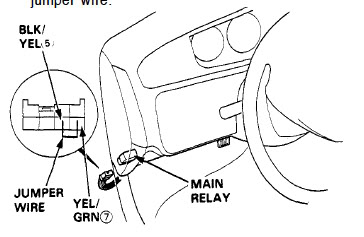
2) Unplug the main relay connector and turn the key to OFF. Measure voltage to body ground at the Yel/Wht wire terminal in the plug (voltage comes from fuse 31). (not shown in diagram; figure out proper terminal by locating wire in plug).
1) Unplug the main relay connector and turn the key to ON(II). Measure voltage to body ground at the Blk/Yel wire terminal in the plug (voltage comes from fuse 24). (see diagram)
2) Unplug the main relay connector and turn the key to OFF. Measure voltage to body ground at the Yel/Wht wire terminal in the plug (voltage comes from fuse 31). (not shown in diagram; figure out proper terminal by locating wire in plug).

Thread Starter
|
HCF Member
Joined: Apr 2010
Posts: 235
From: Harmony, FL
1) I'm getting a flat 11.64V from the blk/yel wire terminal with key ON(II).
2) I'm geting exactly the same from the yel/wht terminal with the key OFF.
Should I have left the key in for #2, or not?
2) I'm geting exactly the same from the yel/wht terminal with the key OFF.
Should I have left the key in for #2, or not?
Recognized HCF Member
Joined: Sep 2007
Posts: 9,453
From: Houston, Texas
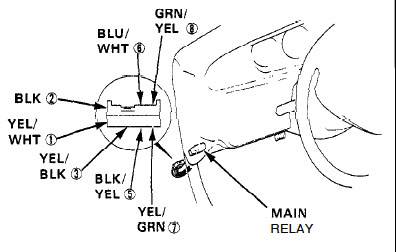
The ignition switch supplies voltage to fuse 24, which transmits the voltage to the main relay, which transmits the voltage to terminals A23 and A24 of the ECU.
Here's what your troubleshooting currently says. Fuse 24 properly transmits voltage to the main relay, but ECU terminals A23 and A24 do not receive it. And swapping in a new main relay does not fix the problem. This suggests a bad main relay plug or a bad Blk wire running between main relay terminal 2 and ECU terminals A23/A24.
Start my measuring the resistance of this Blk wire between the main relay and ECU plugs. Also carefully inspect the terminals and plugs for damage.
Last edited by RonJ; Jul 9, 2010 at 02:26 PM.
Thread Starter
|
HCF Member
Joined: Apr 2010
Posts: 235
From: Harmony, FL
The BLK wire is getting only 0.2Ω to both A23 and A24.
I inspected the plugs, and while the one to the main relay looks like it was chewed on by a dog or something, it looks like the insides where the prongs go into the terminals were unharmed.
I inspected the plugs, and while the one to the main relay looks like it was chewed on by a dog or something, it looks like the insides where the prongs go into the terminals were unharmed.
Recognized HCF Member
Joined: Sep 2007
Posts: 9,453
From: Houston, Texas
How exactly did you do this test?
Post a clear picture of the damaged main relay plug.
I inspected the plugs, and while the one to the main relay looks like it was chewed on by a dog or something, it looks like the insides where the prongs go into the terminals were unharmed.
Recognized HCF Member
Joined: Sep 2007
Posts: 9,453
From: Houston, Texas
If the Blk wire is fine, then your focus should be on the ECU plug or main relay plug, though the main relay itself also can't yet be completely ruled out.
Last edited by RonJ; Jul 9, 2010 at 02:41 PM.
Thread Starter
|
HCF Member
Joined: Apr 2010
Posts: 235
From: Harmony, FL


and one of plug A from the ECU, its a bit chewed from my mulitimeter probes which were too big, but only harmed the plastic.

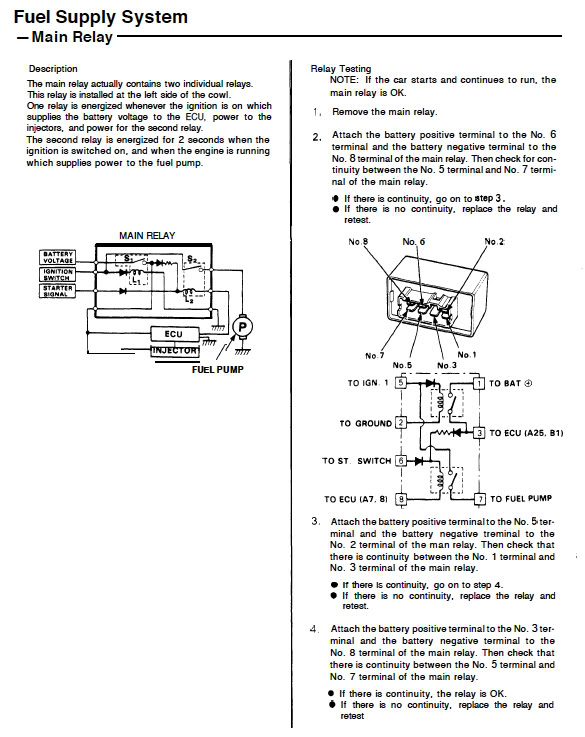
How would I go about hooking up the Main relay to the battery terminals?
Recognized HCF Member
Joined: Sep 2007
Posts: 9,453
From: Houston, Texas
It may be pertinent that the most damaged looking area of the main relay plug is near the Blk/Yel wire of interest. If you reconnect the main relay plug and turn the key to ON(II), do A23 and A24 still show only very low voltage? You may also want to scrape a small amount of insulation from the Blk wire near the main relay plug to check whether battery voltage is detected there.
For A23 and A24, are you testing the two vertical terminal pairs second from the right of the ECU plug in your picture?
To test the main relay, you can connect wires directly to the battery as power and ground sources.
For A23 and A24, are you testing the two vertical terminal pairs second from the right of the ECU plug in your picture?
To test the main relay, you can connect wires directly to the battery as power and ground sources.
Last edited by RonJ; Jul 9, 2010 at 03:06 PM.